
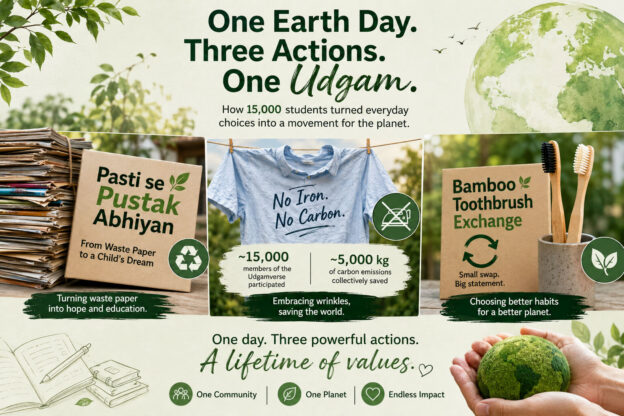
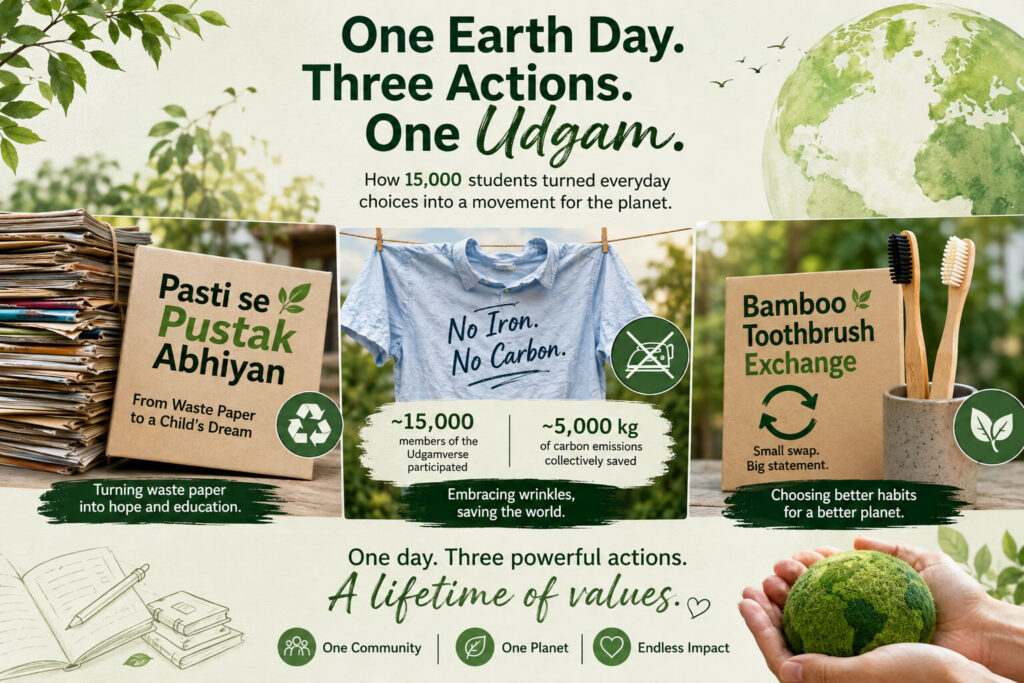
What does Earth Day look like at a school that truly believes in action over applause? It looks like crumpled shirts, bamboo toothbrushes, and stacks of old notebooks—all coming together in one extraordinary day of purpose.
On April 22, 2026, Udgam School for Children didn’t just observe Earth Day. It lived it. Across three distinct yet deeply connected initiatives, students, parents, alumni, and staff chose to do something uncomfortable, something meaningful, something real. Here’s the story of what happened—and why it matters.
Pasti se Pustak Abhiyan — From Waste Paper to a Child’s Dream
It started with a simple question: what if the newspaper piling up in your home could become the notebook a child walks miles to school for?
Led by the Interact Club of Udgam School and Grade XA students, the Pasti se Pustak Abhiyan (Waste Paper to Books Campaign) swept through every corner of the school—from Grade 1 classrooms to Grade 12, from IBCP sections to admin and staff rooms. Students knocked on doors, made announcements, and personally encouraged every member of the Udgam community to donate old notebooks, magazines, newspapers, and unused paper.
“Every effort counts when it comes to sustainability.”
The collected paper waste will be handed over to the Arham Yuva Seva Group, who will recycle it into Pro notebooks—which will then be donated to underprivileged students and municipal schools. In one sweep, Udgam students managed to close the loop between waste and want, between excess and access.
This wasn’t just a collection drive. It was a masterclass in empathy. Young Udgamites learned, firsthand, that responsible consumption doesn’t require grand gestures—it begins with the choice to not throw something away when it can still give back.


No Iron Day — The Day Wrinkles Saved the World
Here’s a number that might surprise you: ironing a single pair of clothes generates up to 200 grams of carbon emissions. Multiply that by millions of households ironing every single morning, and the carbon footprint becomes staggering.
So Udgam did something delightfully rebellious: it asked everyone to skip the iron for one day.
On Earth Day, nearly 15,000 members of the Udgamverse—students, parents, alumni, teachers, and staff—showed up to school, office, and home in their natural, wrinkle-honest clothes. The slogan was simple and sharp: No Iron. No Carbon.
~15,000 members of the Udgamverse participated
~5,000 kg of carbon emissions collectively saved
Five thousand kilograms of carbon. Not from solar panels, not from electric vehicles—but from simply not turning a switch.
Sustainability doesn’t always demand sacrifice. Sometimes, it just asks you to embrace the crease.
Students walked into their classrooms with shirts that told a story. Teachers wore their wrinkles like badges. And together, they proved that environmental action can be joyful, communal, and surprisingly liberating.


Bamboo Toothbrush Exchange — A Small Swap, A Big Statement
Did you know that the first toothbrush ever made is still sitting in a landfill somewhere—largely intact? Plastic toothbrushes take up to 400 years to decompose. And yet, most of us reach for one every single morning without a second thought.
Udgam decided to change that habit—one brush at a time.
In partnership with Arya Sanskriti, an organics store, the school launched a Bamboo Toothbrush Exchange. The deal was simple: bring your old plastic toothbrush, and take home a bamboo one for just Rs. 10.
~4,000 old plastic toothbrushes collected
₹10 cost of a bamboo toothbrush for students
Over 4500 old toothbrushes were collected and will be directed to ragpickers. The proceeds from this initiative will fund the production of more bamboo toothbrushes—which will then be distributed free of cost to municipal school students.
And bamboo toothbrushes aren’t a compromise. They’re soft on gums, durable, cost-effective, and dentist-approved. They are, quite simply, better—for your teeth and for the planet.
“Accessibility has always been the barrier to sustainable choices. We wanted to remove that barrier for our students—and for communities beyond our walls.”


One Day. A Lifetime of Values.
What Udgam School demonstrated on Earth Day 2026 wasn’t just environmental awareness—it was environmental citizenship. Three initiatives, each distinct in its form, but united in spirit:
Paper waste became educational hope. Carbon emissions were avoided with a smile. Plastic was replaced with purpose.
Udgamverse didn’t wait for someone else to act. It looked inward, looked around, and chose—collectively, joyfully, deliberately—to do better.
Because at Udgam, Earth Day isn’t a date on the calendar. It’s a way of thinking that shapes every ordinary Tuesday, every classroom conversation, every small choice made by 15,000 people who know that the planet is not a problem to be solved—it is a responsibility to be honoured.